Can You Just Write Me a Doctor's Note for Work? — 8 Times Patients Asked, and What I Was Actually Thinking
The question almost always comes at the end of the visit. Sometimes embarrassed, sometimes defiant, sometimes so quiet I almost miss it: “Hey, doc — can you just write me a note for work?”
If what you need is the note itself, get a doctor's note online from SickSlip; the rest of this guide covers the rules.
I've heard it hundreds of times by now, and the question itself has started to fascinate me. The version that sticks with me is a woman in her forties who drove forty minutes to the ER at 2 AM with her six-year-old running a 103° fever from strep. She held her son in her lap while asking me, almost apologetically, if I could also write a note — for her — because her manager was counting days.
I wrote the note. I also thought: we've built a country where that was the easiest path she could find.
What most patients don't realize is that “can you just write me a note” isn't one question. It's eight different questions, and my answer depends entirely on which one they're actually asking.
Here are eight real versions I hear every month, what I was actually thinking each time, and what I wish every patient knew before they asked.

Need a note right now?
Physician-reviewed. Employer-accepted. $29.99 flat fee. No waiting room.
Get my doctor's note →1. The patient who feels guilty for being sick
What they said: “I don't want to make a big deal of this — but can you write me a note? My boss doesn't really believe I'm sick.”
What I was thinking: That's a 102 on the thermometer and a positive strep swab. I don't want her to apologize. I want her to sit down.
This is the most common version of the ask, and it gets to me every time. I watch people downplay symptoms while visibly shivering. The guilt isn't rational. It's trained. They're not asking me to bend the truth — they're asking me to validate reality because their workplace culture has taught them their own body isn't trustworthy evidence.
The answer is always yes. If you are genuinely sick, a note isn't a favor. It's documentation of a clinical fact. You don't need to apologize for asking.
2. The post-op patient who needs light duty
What they said: “I can't lift anything over ten pounds for two weeks — can you put that in writing?”
What I was thinking: Yes. And I should have offered before you had to ask.
Work restrictions are part of post-operative care. Whether it's a laparoscopic procedure, a fracture, a cardiac event, or something as routine as a colonoscopy — physical restrictions need documentation to be enforceable. A verbal “take it easy for two weeks” doesn't protect you when your supervisor asks why you can't move a pallet.
The answer is yes, and it should be the default. If your discharge paperwork doesn't include work restrictions in writing, ask. It's your care plan, not a favor.
Need a note right now?
Physician-reviewed. Employer-accepted. $29.99 flat fee. No waiting room.
Get my doctor's note →3. The parent whose child has strep
What they said: “My son has strep. Can you write me a note — not him, me? I need to stay home with him.”
What I was thinking: That's a legitimate medical absence under most state and federal caregiver-leave laws, and HR won't know how to document it.
Caregiver absences are one of the most under-documented categories in American workplace medicine. A child with strep can't return to school for at least 24 hours after starting antibiotics — that's two days of missed daycare or school, which often means two days of lost wages or roughly $180 in backup childcare for a working parent. Someone has to be home with that child. That someone then needs documentation for their own absence — not because they're sick, but because the person they care for is.
The answer is yes. A physician can document a pediatric illness and attest that a parent's presence is medically necessary. If HR treats this as “using your own sick days,” that's a separate conversation — but the documentation is legitimate.
4. The person who drove 30 miles to an ER because their boss demanded a note
What they said: “I've had a stomach bug for two days. My manager said I need an ER doctor's note or I get written up. Can you help?”
What I was thinking: This visit will cost you $1,800–$3,500 depending on your insurance. You didn't need an ER.
This is the most financially brutal version of the ask, and I see it constantly. Employers demand “official” documentation. Patients interpret that as “I need an emergency room.” They show up to spend four hours in a waiting room for a note a telehealth physician could have written in ten minutes. That isn't medicine. It's a broken system charging people for paperwork.
The answer is yes, I'll write the note — but I always tell them: next time, don't come here for this. The ER is the single most expensive and least efficient setting for documentation of a routine illness.
Need a note right now?
Physician-reviewed. Employer-accepted. $29.99 flat fee. No waiting room.
Get my doctor's note →5. The patient whose boss rejected a verbal note
What they said: “My doctor's office called my supervisor, but they said it had to be in writing on letterhead. Can you do that?”
What I was thinking: Of course. But it shouldn't have taken two rounds of phone tag to get here.
Most employers can legally request written documentation for absences longer than three days (it varies by state — California, New York, and a few others have specific rules). Some require official letterhead. Some require a signed electronic document. Some require a QR-verifiable note their HR can scan.
Here's what I tell every patient in this situation: the solution isn't to argue with HR — it's to get documentation they can't refuse. A physician-signed, QR-verifiable, letterhead-formatted note eliminates the argument entirely.
Need a note right now?
Physician-reviewed. Employer-accepted. $29.99 flat fee. No waiting room.
Get my doctor's note →6. The patient who just wanted a day off
What they said: “I'm not really sick, but I've had a rough week — any chance you can write me something?”
What I was thinking: I respect you for being honest, and the answer is no.
This is the ask most people assume defines the whole category. It actually happens far less than you'd think. When it does, I don't lecture and I don't moralize. I say:
“I can't document illness you don't have. But if you're white-knuckling through something else — stress, sleep collapse, a mental-health thing — that's a real clinical conversation. Want to have that one instead?”
About a quarter of the time, that opens a door. A patient who thought they just needed a day off realizes they've been pushing through an actual clinical problem. That becomes a legitimate visit with legitimate documentation.
The answer is no to the original ask — but sometimes yes to the real one underneath it.
Need a note right now?
Physician-reviewed. Employer-accepted. $29.99 flat fee. No waiting room.
Get my doctor's note →7. The patient with a chronic condition flare
What they said: “My migraines have been bad for three days. I have them documented with my neurologist, but my boss doesn't care about old paperwork — can you write me something for this week?”
What I was thinking: Your condition is real. Your frustration is the HR policy, not your medical history.
This is one of the most frustrating categories for me as a physician. Patients with legitimate chronic conditions — migraines, IBS, endometriosis, autoimmune disorders, long-haul COVID — need documentation per flare, not per condition. Workplace policies treat each absence as a fresh “prove you're sick” cycle, even when the underlying diagnosis is settled.
The answer is always yes. A flare is a clinical event. It deserves per-episode documentation. If your employer requires new paperwork every time, that's exhausting and unfair — but the physician's job is to document reality, not argue with policy.
8. The patient who needed a mental-health day
What they said: “I can't do today. I don't know how else to explain it. Can you write something?”
What I was thinking: Yes. And I'm glad you came in instead of no-showing work and making it worse.
Mental-health absences used to be the most stigmatized category. They're still under-documented, but the medical community is catching up to what patients have known for decades: anxiety, depression, acute stress, and burnout produce measurable clinical symptoms, and they are legitimate reasons to miss work.
I don't require patients to justify a mental-health request. I do a brief clinical assessment — mood, sleep, appetite, any safety concerns — and if the picture fits, I document the visit exactly like I would a migraine or a stomach bug. The diagnosis goes on the note as a general term (“acute stress reaction,” “anxiety flare”) that protects patient privacy while still meeting employer documentation requirements. For the full picture on anxiety and depression specifically — what the note says, and the privacy rules that protect your diagnosis — see our physician's guide to doctor's notes for anxiety and depression.
The answer is yes, more often than patients expect. You shouldn't have to perform illness to get care.
Need a note right now?
Physician-reviewed. Employer-accepted. $29.99 flat fee. No waiting room.
Get my doctor's note →What this actually means if you're about to ask
After fifteen years of hearing this question, here's the honest framework I wish every patient had:
- If you're genuinely sick, injured, or recovering — ask. A doctor's note isn't a favor. It's documentation of a clinical event. Physicians who act like you're asking for the moon are the exception, not the norm.
- If your employer demands paper you can't produce verbally — that's a documentation problem, not a medical problem. Any reasonable physician will help.
- If you're genuinely not sick — say so. A good physician would rather have the honest conversation than write a note that doesn't hold up. Sometimes the honest conversation uncovers something real.
- Don't go to the ER for this. I say this as someone who's worked ER shifts: we are the most expensive, slowest, and least appropriate setting for a routine work note. Urgent care is better. Primary care is better. Licensed telehealth — where a real doctor evaluates you by video or async intake — is often the best of all.
That last point is why I eventually stopped just writing notes in the ER and started building a way patients could skip the waiting room entirely. I spent too many shifts watching people with straightforward illness pay $2,000+ in facility fees because their workplace demanded “real” documentation.
If you're reading this because you need a note right now
If you're the mom with her son in her lap, or the ER patient fighting HR over paperwork, or the post-op person who forgot to ask for written restrictions — you have three reasonable options:
- Your primary care doctor — if you have one and they have same-day availability.
- Urgent care — if your condition warrants in-person evaluation (high fever, dehydration, severe pain).
- Licensed telehealth — if your condition doesn't require hands-on examination.
For the third option, SickSlip is the service I built for exactly this moment. A real physician (often me) reads your intake, asks clinical questions, and if a note is medically appropriate, issues one with a QR-verifiable signature your employer can confirm. $29.99, full refund if you don't qualify, no waiting room.
If you don't qualify — because your symptoms don't warrant one, or because you need in-person care — I'll tell you that honestly, the same way I would in the ER.
You shouldn't have to choose between your health and your paycheck. And you definitely shouldn't have to apologize for being sick.
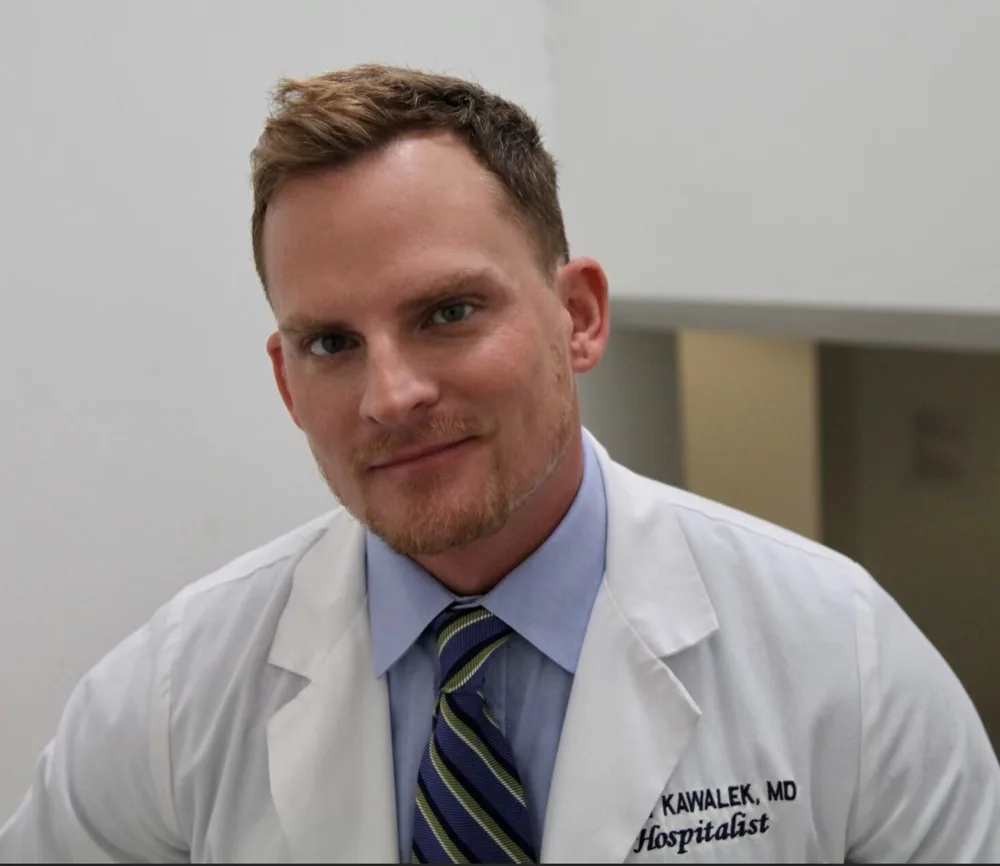
Dr. Adam Z. Kawalek, MD is a board-certified internal medicine physician with 15+ years of clinical experience. He is the founder of SickSlip, licensed in 30+ US states, and holds NPI 1326223306.
Need a note right now?
Physician-reviewed. Employer-accepted. $29.99 flat fee. No waiting room.
Get my doctor's note →Dr. Kawalek is a hospitalist physician with 15+ years of clinical experience. He founded SickSlip to give patients fast, affordable access to legitimate medical documentation without unnecessary clinical barriers.