Doctor's Note for a Flight Refund: What the Airline Needs to See

You bought a non-refundable fare, you woke up with a fever on the day of the flight, and the airline's website says "no refunds." That line is not the whole story. Every major U.S. airline has a medical-exception process that can return the fare, waive the change fee, or issue a credit. What unlocks it is a short letter from a physician. This guide explains what that letter has to say, where to send it, and the three mistakes that get these requests denied.
Short on time? An online doctor's note from SickSlip covers the paperwork; the details below cover the rest.
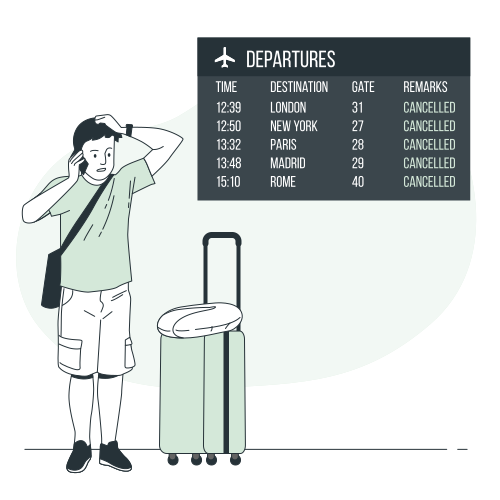
A refund and a change-fee waiver are different requests
Airlines handle sickness two ways. A medical refund returns the money to your card, usually only on fares the airline considers refundable, or when you cancelled before departure and the airline's policy allows a documented medical exception. A change-fee waiver or travel credit keeps the value of the ticket for a future trip and is far more common on basic-economy and non-refundable fares. Ask for the refund first and the credit second. A physician's note supports both requests, but you should name the one you want in your message to the airline.
One thing the note cannot do: it does not override the fare rules by itself. It gives the airline's customer-relations team the documentation they need to apply an exception that already exists in their policy. The stronger and clearer the letter, the easier it is for them to say yes.
What the doctor's note must say
Airline review teams skim. They are checking for a few specific facts, and a note that buries them in a paragraph of medical language is a note that gets sent back. The letter should state:
- Your full name, matching the name on the booking.
- The dates you were medically unable to travel, covering the departure date. If the illness also covered the return, say so.
- A plain statement that you were unable to travel for medical reasons. The airline does not need, and should not be given, your diagnosis. "Medically unable to travel" is the phrase that works.
- The date the physician evaluated you. Most airlines and every travel insurer want the evaluation to have happened at or near the time of the trip, not weeks later.
- The physician's name, license number, state, and signature. A letter that cannot be verified is treated as no letter at all.
- The airline's name and your booking reference, if the note can carry them. It is not required, but it ties the document to the claim and shortens the review.
Notice what is missing: your symptoms, your test results, your medications. Airlines are not entitled to any of that, and including it does not strengthen the claim. It just puts your health information in a customer-service inbox.
Too sick to fly? Get the physician letter your airline asks for.
A board-certified physician reviews your case and signs a note stating you were medically unable to travel on your booked dates. $39.99, addressed to your carrier.
Get my travel note →How the major U.S. airlines handle a sick passenger
Policies change, so check the airline's own page before you submit. As a general picture in 2026:
- Delta, United, and American no longer charge change fees on most main-cabin and above fares, so the practical question is usually whether you can get the value back as a refund rather than a credit. All three review medical refund requests case by case through their refund or customer-relations forms, and all three ask for physician documentation.
- Southwest lets you cancel any fare up to ten minutes before departure and keep the value as a flight credit without any documentation. A doctor's note matters mainly if you missed the cancellation window because you were ill.
- Basic economy on any carrier is the hardest case. These fares are sold as non-changeable and non-refundable, and the medical exception, where one exists, is granted at the airline's discretion. A clear physician letter is the only thing that moves these.
- JetBlue, Alaska, Spirit, and Frontier each publish a refund or exceptions policy and each asks for the same core facts listed above. Spirit and Frontier in particular expect you to submit through their online form rather than by phone.
If you booked through a third-party site such as Expedia or a travel agent, the request usually has to go through them, not the airline. Send them the same letter.

How to submit the request
- Cancel the flight before departure if you can. A no-show is much harder to recover from than a cancelled booking. Even if you are too sick to deal with it, cancel in the app and sort out the refund later.
- Get evaluated within a day or two of the flight. A note written two weeks after the trip, from a physician who did not see you around the travel date, is the single most common reason for denial.
- Use the airline's refund or customer-relations form and attach the physician's letter as a PDF. Phone agents often cannot process medical exceptions.
- Keep the message short. One or two sentences: you were medically unable to travel on the booked date, a physician's letter is attached, and you are requesting a refund (or, failing that, a credit).
- Save everything. The confirmation number of your request, the letter, and any reply. If the airline declines and you believe the policy was not applied, the U.S. Department of Transportation takes consumer complaints about refunds.
The three mistakes that get these requests denied
- A letter dated long after the flight. Airlines treat a late evaluation as a letter written to order. Get seen while you are sick.
- A letter that says the wrong thing. A note that excuses you from work does not say you were unable to travel. Airlines read these literally. The note has to speak to the trip.
- A letter nobody can verify. A scanned note with no license number, no physician name, or no way to confirm it was issued will be set aside. If the airline cannot check it, it does not count.
When the airline wants its own medical form
Some carriers, and nearly all travel insurers, go a step further and ask the physician to complete their own form rather than accept a letter. Those forms ask for things a letter does not, such as the date of onset, whether the condition was pre-existing, and the physician's own assessment of fitness to travel. A standard note will not satisfy them. If your airline or insurer has sent you a form, you need a physician who will see you and complete it, which is a different service from a signed note.
What a SickSlip travel note is, and is not
A SickSlip travel note is a physician-signed letter stating that you were medically unable to travel on your booked dates. It carries the physician's name, state license number, and a verification code the airline can check. It can be addressed to your carrier and can include your booking reference. It costs $39.99 and is issued the same day; over the last three months the typical request was signed in under 20 minutes. It is not a completed airline or insurer medical form, and it is not a fitness-to-fly clearance, which is a separate kind of document that says the opposite: that you are well enough to board.
If you are already dealing with a cancelled hotel or cruise as well, the guide to doctor's notes for a cancelled trip covers how those companies handle medical cancellations. If a travel insurer is involved, read what a travel-insurance claim letter must say before you file.
Too sick to fly? Get the physician letter your airline asks for.
A board-certified physician reviews your case and signs a note stating you were medically unable to travel on your booked dates. $39.99, addressed to your carrier.
Get my travel note →A final word from the physician
Flying sick is bad for you and for the people in the rows around you, and airlines know it. The medical-exception process exists so that staying home is not a financial penalty. Use it. Get evaluated while you are unwell, ask for the letter to say what the airline needs, and submit it through the right channel. Most of the denials I hear about come down to timing and wording, and both are fixable.
Will an airline give me a refund for being sick?
What does a doctor's note for a flight refund need to say?
Does the note have to include my diagnosis?
How soon after the flight do I need to see a doctor?
Can I get the note online?
What if the airline asks for its own medical form?
Is a fit-to-fly letter the same thing?
Too sick to fly? Get the physician letter your airline asks for.
A board-certified physician reviews your case and signs a note stating you were medically unable to travel on your booked dates. $39.99, addressed to your carrier.
Get my travel note →Dr. Kawalek is a hospitalist physician with 15+ years of clinical experience. He founded SickSlip to give patients fast, affordable access to legitimate medical documentation without unnecessary clinical barriers.